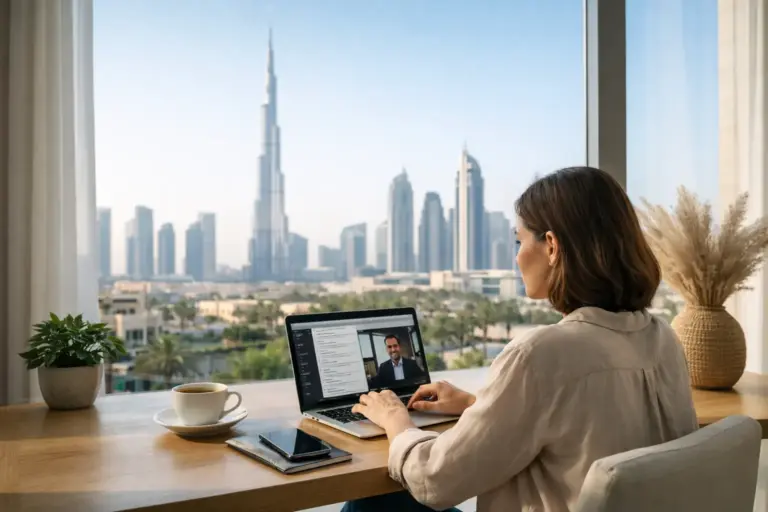


A Dubai-based marketing manager collaborating with a team in Riyadh, London, and Mumbai is no longer an unusual hiring story. It is increasingly how business gets done. Remote work trends UAE are creating more options for professionals who want flexibility and for employers that need specialized talent without limiting their search to one office location.
The opportunity is real, but so is the competition. Remote roles can attract applicants from across the Emirates and around the world. Candidates who treat a remote job search like a standard application process may get overlooked. The candidates getting interviews are proving they can deliver outcomes, communicate clearly, and work independently from day one.
Remote Work Trends UAE Employers Are Following
The UAE remains a relationship-driven business market, and many organizations still value in-person collaboration. That means fully remote work has not replaced office-based hiring across every sector. Instead, the strongest shift is toward choice: hybrid schedules, remote-first teams, flexible contracts, and cross-border hiring for roles that can be measured by output rather than desk time.
Technology companies, digital agencies, fintech firms, consultancies, e-commerce businesses, and global service providers are leading this change. They need access to talent quickly, often for projects that move faster than traditional hiring cycles. A company in Dubai may hire a software engineer in Abu Dhabi, a paid media specialist in Sharjah, or a customer success professional based outside the UAE, provided the working arrangement meets business and legal requirements.
For candidates, this expands the definition of an UAE job. Your next employer may have a Dubai headquarters but a distributed team. Or it may be an international company that wants UAE market knowledge, Arabic language capability, Gulf-region sales experience, or overlap with local business hours.
Hybrid is often the practical middle ground
For many UAE employers, hybrid work is the model gaining the most traction. It offers flexibility while protecting the face-to-face interaction that matters for client meetings, onboarding, leadership decisions, and team culture. A role advertised as hybrid may require two or three office days each week, with the rest completed remotely.
This matters because candidates should not assume that “remote” means work from anywhere with no location expectations. Read each posting carefully. Some jobs are remote within the UAE only because of payroll, tax, visa, security, or client requirements. Others are open to global candidates but require availability during Gulf Standard Time.
Skills matter more than proximity
When managers cannot observe work in an office every day, they focus more intensely on evidence of performance. They want candidates who can explain what they delivered, how they prioritized work, and how they kept stakeholders informed.
That gives capable professionals a powerful advantage. A strong portfolio, quantified resume achievements, relevant certifications, and examples of independent project ownership can outweigh a candidate living closer to the office. Remote hiring rewards proof over promises.
The Remote Jobs Showing the Strongest Demand
Remote work is not equally available in every industry. Roles tied to physical sites, equipment, front-desk service, clinical care, or on-location hospitality naturally have fewer remote options. Yet even in traditionally office-based fields, support functions are becoming more flexible.
Technology remains a major source of remote opportunity. Employers continue to seek software developers, cloud engineers, cybersecurity analysts, data analysts, product managers, UI/UX designers, QA specialists, and IT support professionals. These roles are well suited to digital collaboration, and employers can assess candidates through technical skills, project work, and measurable delivery.
Sales and marketing are also active remote categories. Demand includes business development representatives, account managers, digital marketers, SEO specialists, content marketers, performance marketing professionals, social media managers, and customer success teams. UAE employers value candidates who understand local buyer behavior while also knowing how to use CRM platforms, marketing automation tools, and data to improve revenue results.
Finance, HR, recruitment, operations, and professional services are seeing selective growth as well. Remote-friendly openings can include financial analysts, bookkeepers, recruiters, payroll coordinators, executive assistants, project coordinators, and compliance support specialists. The deciding factor is usually confidentiality, process maturity, and whether the role requires routine physical presence.
Freelance and contract work are another meaningful part of the market. Companies may bring in a designer for a launch, a recruiter for a high-volume hiring project, or a consultant for a regional expansion. These assignments can lead to longer engagements, but they require candidates to be clear on scope, payment terms, availability, and whether a UAE work permit or business setup is needed.
What UAE Employers Expect From Remote Candidates
A remote role is not simply an office job performed from home. It requires a different operating style. The most competitive candidates show that they can manage work without constant supervision while keeping managers confident that priorities are moving forward.
Communication is the first test. Employers want people who write clear updates, ask focused questions, document decisions, and raise risks early. In a distributed team, silence can look like delay. A short, structured progress message can build more trust than a long meeting with no action plan.
Time management is equally important. Hiring managers look for candidates who can organize their workload, meet deadlines, and work across time zones without burning out. If you have managed competing priorities, coordinated with remote stakeholders, or delivered projects with limited direction, put that experience directly on your resume.
Digital fluency also matters. You do not need to claim expertise in every platform, but you should be comfortable with the tools relevant to your role, such as video conferencing, project management systems, shared documents, CRM software, analytics dashboards, or collaborative design platforms. The goal is not to sound technical. It is to show that you can become productive quickly.
How to Position Yourself for Remote UAE Roles
Start by making your resume specific to remote performance. Replace vague claims such as “excellent team player” with evidence. For example, describe how you managed client accounts across multiple markets, reduced campaign reporting time, improved response rates, or completed a project ahead of deadline while working with distributed colleagues.
Your professional profile should answer three questions fast: what you do, what outcomes you create, and why you can work effectively in a flexible environment. If you are targeting UAE roles from overseas, state your location, time-zone availability, and relocation or remote-work preference clearly. This prevents avoidable confusion for recruiters.
Tailor every application to the job description. Remote employers commonly use applicant tracking systems to manage high application volumes, so relevant keywords, skills, and achievements need to be easy to find. An ATS-friendly resume is not about stuffing phrases into every line. It is about matching your real experience to the capabilities the employer needs.
Prepare for interviews differently, too. Expect questions about autonomy, communication, difficult feedback, and remote collaboration. Build concise stories using real examples: a time you handled an urgent issue independently, aligned a team across locations, or recovered a project that was falling behind. Results make the story credible.
Dr.Job UAE can help candidates move faster by combining remote and UAE job discovery with AI-powered resume, application, and interview preparation tools. The smarter approach is not sending more generic applications. It is sending stronger, role-matched applications while staying organized enough to follow up promptly.
The Trade-Offs Behind Flexible Work
Remote work can reduce commuting time and widen access to employers, but it is not automatically easier. Some professionals miss spontaneous mentorship, social connection, and the clearer boundaries that come with leaving an office. Others find that hybrid roles create the best balance because they combine focused remote work with regular in-person visibility.
There are employer trade-offs as well. Distributed teams can access broader talent and reduce location constraints, but they need strong onboarding, clear processes, dependable security, and managers who judge performance fairly. Companies with unclear expectations often struggle more with remote work than companies with remote staff.
Candidates should also consider compensation carefully. A remote role may offer flexibility but a lower salary than a location-based position, or it may pay competitively because the skills are scarce. Look beyond the headline number. Consider health coverage, visa sponsorship, annual leave, learning support, home-office allowances, career progression, and how often travel or office attendance is expected.
Make Flexibility Part of Your Career Advantage
The UAE job market is moving toward more flexible ways of hiring, not toward one universal work model. Candidates who can combine specialist skills with visible accountability will have the strongest options, whether they want a fully remote role, a hybrid schedule, or a global position connected to the UAE.
Build a profile that makes employers confident before the first interview: clear results, relevant tools, reliable communication, and a practical understanding of the work arrangement. Flexibility becomes a career advantage when you can prove that distance will never reduce your impact.